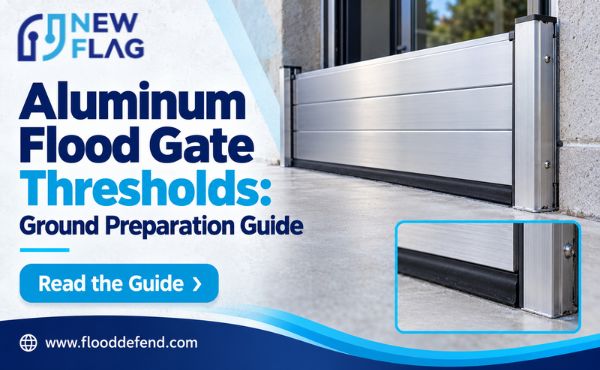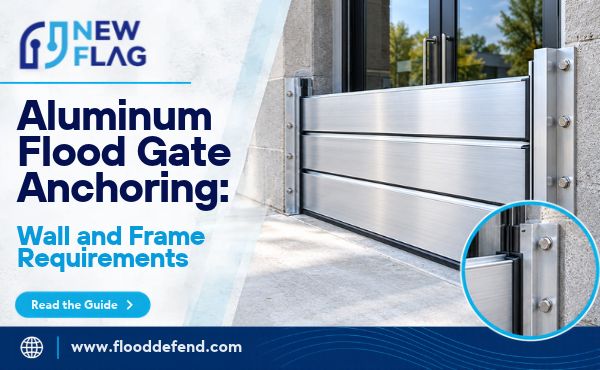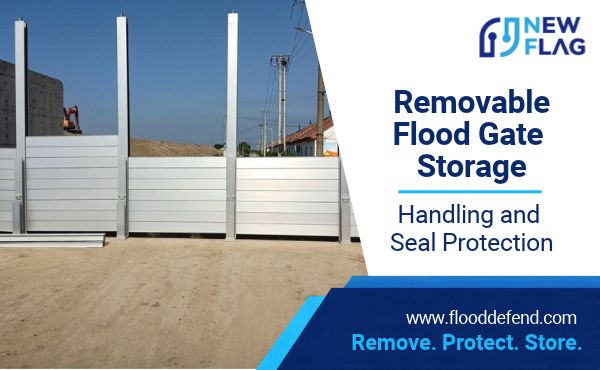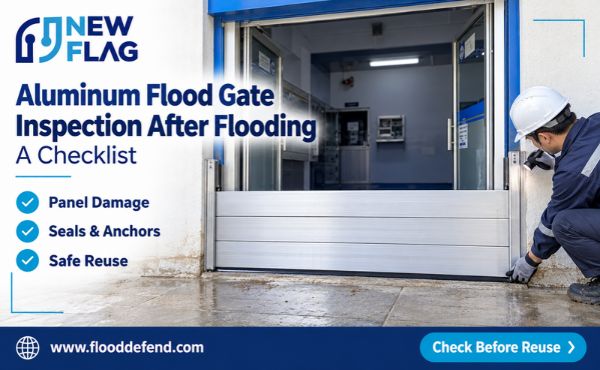
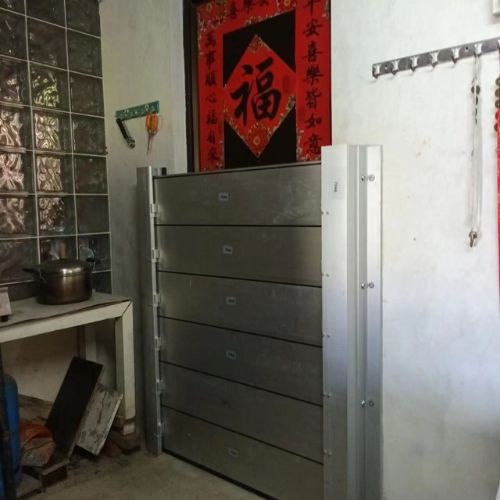
An aluminum flood gate threshold must provide the continuous contact surface required by the gate’s bottom seal. Preparation may involve cleaning, repairing local defects, or constructing an approved sill detail. The correct solution depends on the surveyed floor profile and the selected gate; there is no universal rule that every entrance must be perfectly horizontal or receive a raised concrete curb.
For contractors and facility owners, the aim is to make the sealing line compatible with the product without creating new drainage or access problems. A bottom gasket cannot be expected to bridge every channel, open joint, or change in level simply because it is flexible.
The Actual Bottom Sealing Line
Identify where the deployed gate contacts the ground. This line may be inside the reveal, on the existing door sill, or outside the doorway. Inspect that location specifically rather than judging the general entrance floor.
Mark the line on a photograph and plan. Include the side-frame positions because the bottom seal must connect correctly with the side seals. Ground preparation that changes only the center of the opening can leave unsuitable conditions at the corners.
Record the threshold elevation against the reference used for the flood protection design. If the prepared sill will change that elevation, show the revised level before fabrication. Raising or lowering the contact line affects the relationship between water depth and the gate’s physical height.
Check whether the gate rests directly on the finished floor or uses a separate sill plate. A sill plate may provide a controlled surface, but its edges and connection to the building also need a water-resistant detail. A flat metal strip placed over a water path does not automatically close it.
Slope, Steps, and Local Irregularities
Separate a broad slope from a local gap. A gradual crossfall changes the overall panel-to-floor relationship. A narrow groove or depression can create a direct route beneath the gasket even when the surrounding surface is otherwise suitable.
Use a straightedge and level measurements to describe the profile. Record the position and depth of depressions, projections, and steps. For a wide opening, measure at intermediate points so the supplier can see the full shape rather than only the two ends.
The allowable profile depends on the seal design and gate arrangement. Some engineered systems can accommodate slopes or stepped installations; others need a prepared level contact surface. Do not transfer one product’s advertised slope capability to another aluminum flood gate.
Ask the supplier to define the approved surface geometry and how compliance will be checked. “Smooth and level” can be too vague for a construction handover. The drawing or installation specification should establish measurable requirements where needed.
Do not assume greater gasket thickness is an interchangeable solution. It changes compression travel and may alter the corner contact with the side frames. Surface correction and seal selection should be coordinated by the responsible designer.
Joints, Tracks, and Drainage Channels
Tile grout lines, expansion joints, automatic-door tracks, and mat recesses deserve individual attention. Their importance depends on whether they cross the sealing path and whether they continue beneath the surrounding finishes.
A surface joint may need an approved flexible sealing detail rather than rigid filling. If it is intended to accommodate building movement, simply covering it with brittle repair material can produce a new crack. Establish the joint’s function before choosing the repair.
Recessed tracks can have complex profiles and drain paths. A gasket pressed onto the raised edges may still leave a channel beneath it. Record the cross-section and show how the proposed gate will close that route.
Drainage should remain functional during ordinary operation. Blocking a trench or sill drain permanently may cause routine rainwater to collect at the entrance. Any closure used during flooding needs a design that explains normal drainage and flood deployment separately.
Also examine joints at the base of the side frames. Water can pass behind a frame and emerge near the bottom, making the threshold appear to be the sole cause. Ground preparation must connect to the complete frame-to-building sealing detail.
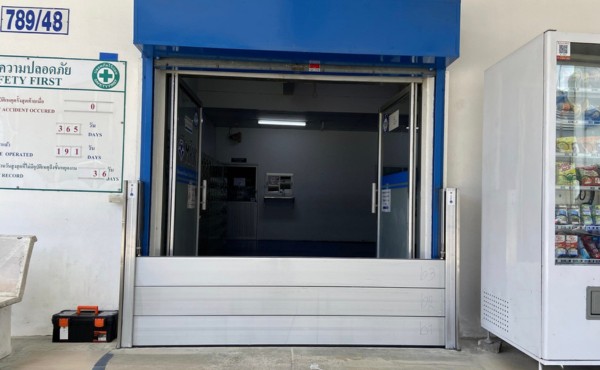
Repair, Leveling, and New Sill Options
Where damage is local, repair may be sufficient. Remove loose material, identify the cause of deterioration, and select a repair compatible with the substrate and service conditions. A thin cosmetic coating over a cracked or unstable base is unlikely to provide a durable contact surface.
Where the entire profile is unsuitable, a designed leveling strip or sill may be necessary. Its support, adhesion or anchorage, edge geometry, and connection to adjacent surfaces need assessment. The gate supplier should approve the finished sealing face.
| Existing condition | Preparation option to assess | Main design question |
|---|---|---|
| Sound surface with grit | Cleaning | Is the intended contact line fully clear? |
| Local chips or pits | Compatible repair | Will the repair remain bonded and flush? |
| Broad uneven profile | Designed leveling detail | Does the final profile match the seal range? |
| Track or crossing groove | Purpose-designed closure or sill | Is the complete water path closed? |
| Weak or moving base | Substrate repair or replacement | Is the support stable under service loads? |
The options are not installation instructions. Material thicknesses, curing periods, fastening methods, and permissible finishes depend on the approved design and selected construction products.
Coordinate sill work with side-frame installation. A changed floor level can affect panel seating and compression hardware travel. Establish the final level before fixed frame positions become difficult to alter.
Everyday Access and Surface Durability
Assess the prepared threshold in its normal operating state. A raised detail can affect trolley wheels, mobility aids, and door clearance. A recessed connection can collect dirt or create an edge that is difficult to clean.
Check the traffic expected over the surface. A sill in a warehouse entrance may encounter pallet trucks or vehicle tires, while a retail entrance may receive frequent pedestrian traffic and cleaning equipment. The finish must retain its sealing geometry under that use.
Avoid sharp edges along the gasket path. They can cut the seal during insertion or removal. Protect temporary work areas until the approved finish is ready, and inspect the surface again after other trades complete their tasks.
Consider cleaning practices. Repeated aggressive scraping can damage a coating or seal contact face. Include the threshold in the gate’s maintenance instructions so normal facility cleaning does not gradually undermine the flood detail.
If a sill plate or cover is removable, define where it is stored and when it is installed. The deployment plan must include it as a required component rather than treating it as an optional accessory.
Inspection and Acceptance
Before accepting the threshold, verify the finished profile against the approved requirements. Check the entire sealing line, corners, joints, and interface with permanent frames. Photograph the completed condition for later comparison.
Confirm that repair materials and installation sealants have reached the condition required before the gate is used or tested. Do not assume every product is ready for water exposure immediately after application.
Carry out a dry gate assembly. Observe whether the panel seats correctly and the compression mechanism operates within its specified range. Difficulty seating the gate can indicate a profile or alignment problem despite an apparently neat finish.
Where a field water test is specified, use the agreed procedure and acceptance criteria. A casual hose spray does not reproduce the same loading as retained water, while an improvised ponding test can introduce unmanaged risk.
Document any later alteration to flooring or entrance tracks. A replacement tile, new mat recess, or resurfacing project can change the contact geometry. Require reassessment before assuming the existing flood gate remains compatible.
Conclusion
Ground preparation for an Aluminum flood gate should create the contact geometry the selected system needs while preserving normal access and drainage. Survey the actual sealing line, distinguish broad slope from local water paths, and coordinate repairs with the frames and corners. Accept the completed threshold through documented checks and a correctly seated gate.