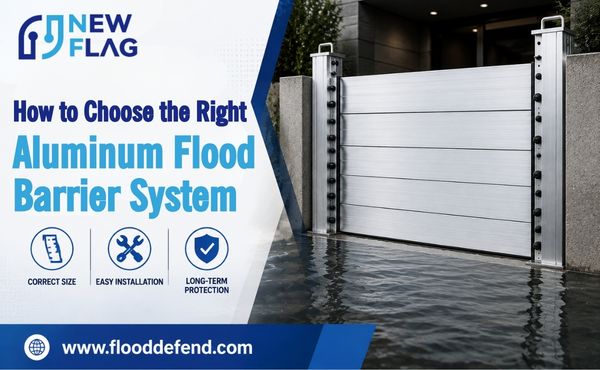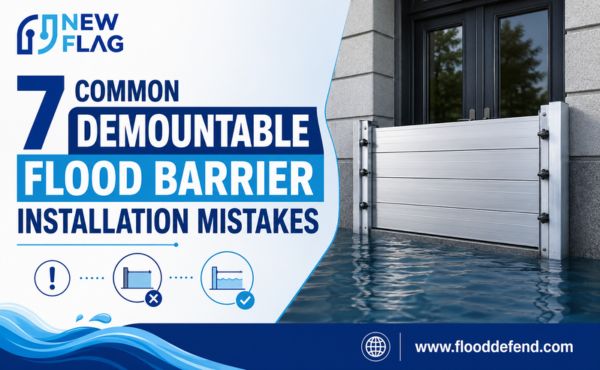
A demountable flood barrier can provide reliable temporary protection for doorways, garages, warehouses, commercial buildings, and perimeter areas. However, its performance depends heavily on correct measurement, site preparation, installation, sealing, and maintenance.
Even a high-quality system may leak or shift if the panels, posts, anchors, or seals are installed incorrectly. Understanding common demountable flood barrier installation mistakes can help property owners, contractors, and facility managers improve deployment efficiency and reduce the risk of floodwater entering protected areas.
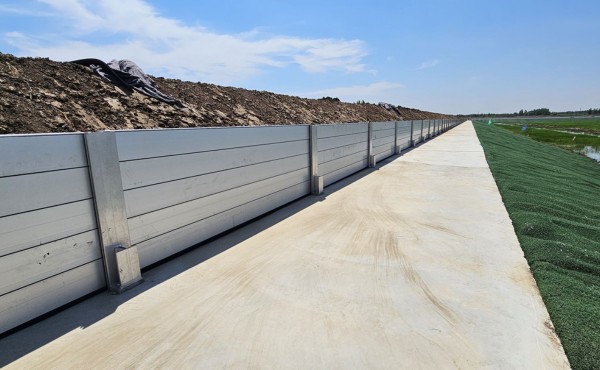
1. Taking Incorrect Opening Measurements
Accurate measurements are the starting point of every successful demountable flood barrier installation. Small errors in width, height, or surface level can lead to poor fitting, weak sealing, and difficult panel installation.
Measuring the Opening Only Once
Some installers measure an entrance at only one point. However, walls, floors, and door openings are not always perfectly straight or square.
The width should be measured at the top, middle, and bottom of the opening. The height and ground level should also be checked at several points. Using only one measurement may result in barrier panels that are too long, too short, or unable to fit correctly between the side posts.
Use a metal tape measure and record every result carefully. For irregular openings, professional site measurement may be necessary before production.
Ignoring the Installation Components
The total opening width is not always the same as the required barrier panel length. Side posts, intermediate posts, seals, fixing plates, and installation clearances must also be considered.
Before ordering a demountable flood barrier, confirm:
- The clear opening width
- The required flood protection height
- The wall and ground conditions
- The side post dimensions
- The number of intermediate posts
- The required panel overlap or clearance
Providing complete site information helps the manufacturer recommend the correct configuration.
2. Failing to Prepare the Installation Surface
A demountable flood barrier depends on close contact between its sealing components and the surrounding structure. Dirt, cracks, uneven pavement, and damaged walls can prevent the barrier from forming a reliable seal.
Installing Over Dirt or Debris
Leaves, sand, gravel, oil, construction waste, and other debris may create small gaps under the bottom seal or around the side posts. Floodwater can pass through these openings even when the panels appear to be installed correctly.
Before installation, clean the ground and wall surfaces thoroughly. Remove loose materials and make sure the contact areas are dry enough for inspection.
The installation area should also remain clear during storage and emergency deployment. Keeping a cleaning brush, cloth, and basic tools near the barrier components can help reduce preparation time.
Ignoring Cracks and Uneven Ground
Large cracks, damaged concrete, loose tiles, and uneven pavement may reduce sealing performance. A bottom seal cannot compensate for every surface defect.
Inspect the installation area before the flood season. Repair visible cracks, fill unnecessary gaps, and check whether the ground provides continuous support across the barrier opening.
For permanent side posts or ground-mounted components, the supporting structure must be strong enough to resist the expected floodwater pressure. Weak masonry or damaged concrete should be repaired before anchors are installed.
3. Installing Posts and Anchors Incorrectly
Side posts and intermediate posts transfer water pressure from the barrier panels to the surrounding structure. Incorrect positioning or weak anchoring can cause the system to move, tilt, or lose its seal.
Misaligning the Side Posts
The two side posts must be installed at the correct distance and remain vertically aligned. If one post is tilted or positioned incorrectly, the barrier panels may become difficult to insert.
Misalignment may also create uneven pressure on the side seals. One side may be compressed too much while the other side remains loose, increasing the risk of leakage.
During installation, use appropriate measuring and leveling tools. Check the distance between posts at several heights before tightening all fixings.
Using Unsuitable Anchors
Anchors should be selected according to the wall material, ground structure, barrier height, and expected water pressure. Using general-purpose screws or makeshift fixing methods may not provide sufficient strength.
Concrete, brick, steel, and other structures may require different anchor types. Installers should follow the manufacturer’s drawings and fixing instructions rather than selecting anchors based only on convenience.
All anchor points should be inspected before the flood season. Loose bolts, corrosion, damaged threads, or movement around the fixing holes should be corrected immediately.
Incorrect Intermediate Post Placement
Long barrier spans often require intermediate posts for additional structural support. Placing these posts at the wrong spacing may increase panel deflection under water pressure.
Intermediate posts should be installed according to the approved system layout. Their base plates or ground sockets must remain stable, level, and properly connected to the supporting surface.
4. Failing to Inspect and Compress the Seals
Sealing components are essential to the performance of a demountable flood barrier. Side seals, panel seals, and bottom seals help limit water leakage around the barrier system.
Installing Dirty or Damaged Seals
Dust, sand, stones, and other particles can become trapped between the seals and the installation surface. This may prevent continuous contact and create leakage paths.
Before deployment, inspect all EPDM or other sealing strips. Clean them with suitable materials and check for:
- Cracks
- Cuts
- Permanent deformation
- Missing sections
- Hardening
- Loose adhesive
- Surface contamination
Damaged seals should be replaced with compatible components. Using an incorrect seal size or material may affect both compression and durability.
Applying Uneven Compression
Demountable flood barrier systems usually require controlled compression to create a tight seal. If the tightening devices are too loose, water may pass through the joints. If they are overtightened, the seals or panels may become damaged.
Install each panel in the correct sequence and apply pressure evenly across the barrier. Follow the manufacturer’s instructions for clamps, locking devices, top compression mechanisms, or tightening bolts.
After installation, visually check the contact between the seals, panels, posts, and ground. The seals should remain continuous without obvious twisting or displacement.
5. Installing the Barrier Panels Incorrectly
Barrier panels must be inserted, stacked, and locked according to the system design. Missing or incorrectly positioned components can reduce the effective flood protection height.
Using the Wrong Panel Sequence
Some demountable flood barriers use panels with specific top, middle, or bottom positions. Installing them in the wrong order may affect the connection between panels or the compression of the bottom seal.
Check all component labels before deployment. Store the panels in installation order whenever possible so that the correct parts can be identified quickly during an emergency.
Each panel should be lowered carefully between the posts. Avoid forcing a panel into position, as this may damage the post channels, panel edges, or seals.
Leaving Gaps Between Panels
Stacked panels must connect closely to form a continuous flood wall. Dirt, damaged seals, incorrect alignment, or incomplete compression may leave gaps between the horizontal joints.
After inserting each panel, check that it sits evenly across the full span. Do not install the next panel until the previous one is correctly positioned.
Forgetting Locking Components
An incomplete installation may look secure but fail when water pressure rises. Missing locking pins, clamps, bolts, top beams, or compression devices can allow panels to move.
Use an installation checklist to confirm that every required component has been installed. A final inspection should be completed by a trained person before the barrier is considered ready.
6. Deploying the Flood Barrier Too Late
A demountable flood barrier is designed for rapid installation, but it still requires sufficient preparation time. Waiting until floodwater reaches the entrance can lead to rushed work and unsafe conditions.
Waiting Until Water Levels Rise
Installing a barrier during active flooding increases the risk of incorrect measurements, missing parts, poor sealing, and personal injury. Water may also prevent the bottom seal from contacting the ground correctly.
Facility managers should monitor local weather warnings and flood alerts. The barrier should be deployed before water reaches the protected area.
A clear activation procedure should define:
- Who makes the deployment decision
- Who retrieves the components
- Who cleans the installation area
- Who installs the posts and panels
- Who completes the final inspection
Storing Components Too Far Away
Barrier panels and removable posts should be stored in a dry, secure, and accessible location. If components are stored in different buildings or behind other equipment, valuable installation time may be lost.
Use labeled storage racks or containers. Keep fasteners, tools, seals, and instructions together with the main barrier components.
Regular training helps installation teams understand their responsibilities. Practice deployment before the flood season and record how long the full process takes.
7. Ignoring Drainage, Testing, and Maintenance
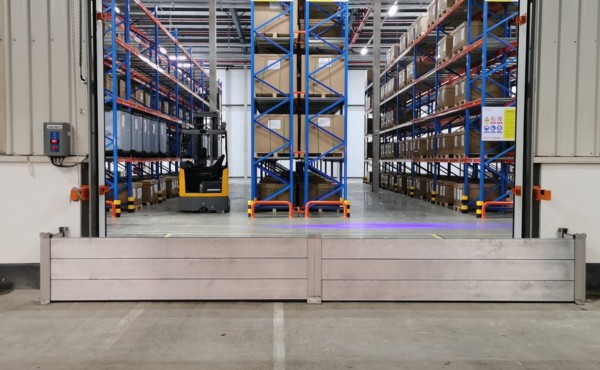
Installing the barrier is not the final step. Drainage conditions, system testing, and routine maintenance all affect long-term flood protection performance.
Forgetting About Trapped Water
A flood barrier blocks external water, but rainwater, groundwater, pipe leakage, or internal drainage may still create water buildup behind the protected area.
Blocked drains and poor surface slopes can cause pooling near the barrier. In some cases, pumps or alternative drainage routes may be required.
Before deployment, inspect all drains and confirm that water can move away from the protected area. Drainage planning should be included in the overall flood protection strategy.
Skipping a Test Installation
The first installation should not take place during an emergency. A test installation allows the team to identify missing components, alignment problems, damaged seals, unclear instructions, and storage issues.
Install the complete system under controlled conditions. Check whether the panels fit correctly and whether all compression devices work as intended.
A controlled water test may also help identify leakage points, provided it is permitted by the manufacturer and suitable for the installation site.
Neglecting Post-Flood Maintenance
After a flood event, remove and clean the demountable flood barrier according to the manufacturer’s recommendations. Mud, salt, sand, and contaminated water may damage seals or metal surfaces if they are not removed.
Inspect the system for:
- Bent panels
- Damaged post channels
- Loose anchors
- Corrosion
- Worn seals
- Missing fasteners
- Damaged locking devices
Allow all components to dry before storage. Record inspection dates, damage, replacement parts, and maintenance work in a logbook.
Demountable Flood Barrier Installation Checklist
Before declaring the system ready, confirm that:
- The opening dimensions match the barrier configuration
- The ground and walls are clean and stable
- Side posts are aligned correctly
- Anchors and fixings are secure
- Intermediate posts are installed where required
- Panels are inserted in the correct order
- All seals are clean and undamaged
- Compression devices are tightened evenly
- Locking components are installed
- Nearby drains are clear
- The installation has received a final inspection
Conclusion
Avoiding common demountable flood barrier installation mistakes is essential for reliable flood protection. Accurate measurements, stable anchoring, clean sealing surfaces, correct panel placement, early deployment, and regular maintenance all contribute to system performance.
Property owners and project managers should complete a test installation before the flood season and ensure that all team members understand the deployment procedure. When site conditions or installation requirements are unclear, consult the flood barrier manufacturer for technical guidance and a suitable system configuration.