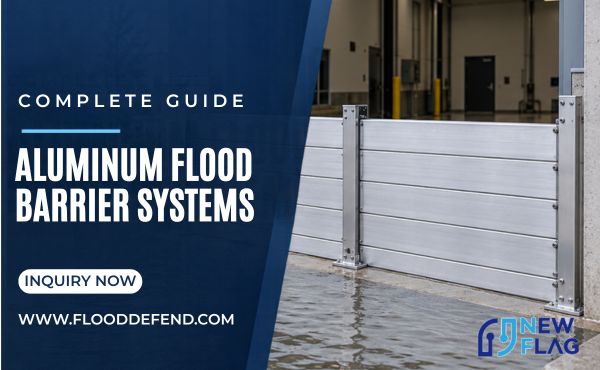
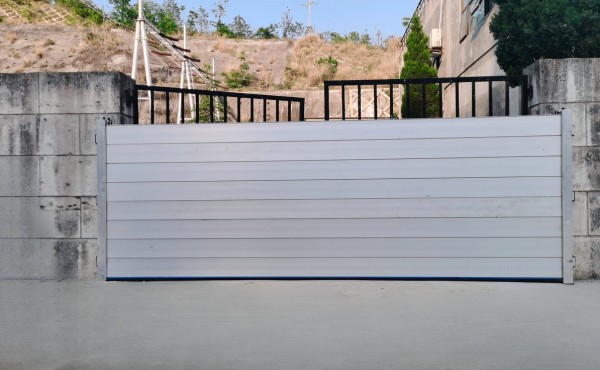
Aluminum flood barrier systems are assemblies used to protect doorways, loading bays, driveways, equipment areas, and property perimeters from floodwater. Most combine removable aluminum planks or panels with wall channels, posts, seals, compression devices, and structural anchors.
Performance does not depend on aluminum alone. Barrier height, span, structural support, seals, drainage, and deployment all matter. Buyers should evaluate complete systems for defined site conditions rather than compare only panel thickness or price.
How Aluminum Flood Barrier Systems Work
Floodwater creates pressure against the barrier face, and that pressure increases with water depth. Aluminum planks transfer the load into side channels or intermediate posts. These components then transfer it through anchors and base connections into walls, floors, or dedicated foundations.
Adding more planks is therefore not automatically a safe way to increase protection height. Taller barriers and wider spans may require stronger profiles, closer posts, different anchors, or structural reinforcement.
Seals provide the second part of the system. Horizontal gaskets limit leakage between stacked planks, while vertical and bottom seals close the interfaces with channels, posts, and thresholds. Clamps or top compression devices apply pressure to these seals.
Flood protection barriers should not be assumed to create completely watertight spaces. Water may enter through worn gaskets, uneven thresholds, drains, penetrations, or adjoining areas. Sumps or pumps may therefore be needed for leakage, rainfall, and seepage.
Main Components and Their Functions
The exact arrangement varies, but most demountable flood barriers use the following elements:
| Component | Function | Important Project Check |
|---|---|---|
| Aluminum planks or panels | Span openings and resist water loads | Verified height, width, and allowable span |
| Wall channels | Support plank ends and transfer reactions | Wall material and anchor capacity |
| Intermediate posts | Divide long runs into manageable spans | Base connection and foundation strength |
| Gaskets and seals | Limit water passage at joints and edges | Material compatibility and replacement access |
| Compression hardware | Maintains consistent seal pressure | Correct installation sequence |
| Anchors and fasteners | Connect barriers to supporting structures | Embedment, edge distance, and corrosion exposure |
| Ground sockets or rails | Locate posts or provide a base interface | Drainage, level tolerance, and traffic loading |
Quotations may exclude threshold leveling, foundations, drainage, wall repairs, waterproofing, and concealed structural supports.
Aluminum combines relatively low handling weight with profiles shaped for stacking and sealing. Material choice alone does not establish performance: alloy, temper, profile geometry, connections, span, finish, fasteners, and exposure must be specified. Aggressive environments also require compatible corrosion-control details.
Opening Barriers or Perimeter Barriers?
Opening barriers protect doors, gates, garage entrances, and loading bays. They use less barrier length than perimeter systems but remain effective only if nearby walls, vents, drains, and penetrations do not provide lower water routes.
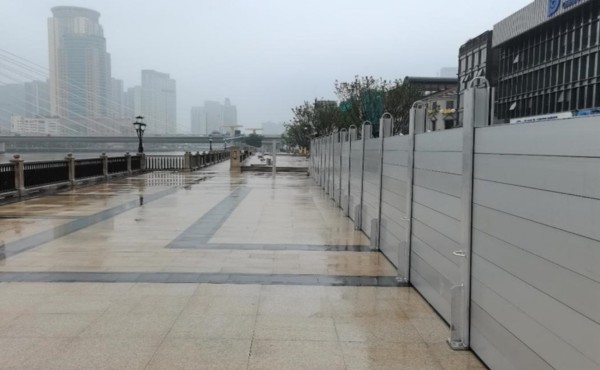
Perimeter barriers form modular defense lines around buildings, utilities, or machinery. Intermediate and corner posts support straight or angled layouts. Ground levels, end returns, foundations, access, and routes around barrier ends all require review.
Demountable aluminum stop logs suit sites that require normal access and have enough warning time for installation. Hinged or sliding gates may close faster but need operating clearance. Passive barriers reduce dependence on staff but usually require more civil work. Operational readiness is therefore as important as structural capacity.
Stop-log systems stack interlocking planks, while flood-panel systems use larger closures. Component weight, storage, installation sequence, span, and number of sealed joints determine which format fits the opening.
What to Check Before Selecting Aluminum Flood Barriers
Establish the Design Flood Conditions
Do not select height from a previous flood mark alone. Establish the design flood elevation and required freeboard, then distinguish standing water from fast flow, waves, coastal surge, and debris exposure.
Static-water performance does not confirm suitability for waves, rapid currents, or impact. These loads require relevant design evidence or testing.
Verify the Supporting Structure
Engineers may need to confirm wall type, concrete strength, slab thickness, reinforcement, anchor spacing, and substrate condition. Cladding, masonry veneers, weak blockwork, and cracked concrete are not automatically suitable supports.
Strong barriers cannot compensate for low vents, open drains, unsealed penetrations, weak glazing, or water passing around the protected line.
Evaluate Deployment Capacity
Compare the available warning period with the time needed to authorize closure, reach the site, move stored components, assemble every section, and inspect the line.
A one-door demonstration does not prove full-site deployment speed. Conduct timed drills with the intended crew, tools, transport, and storage location, including difficult staffing and access conditions.
Plan for Leakage and Overtopping
Confirm the system’s stated leakage criteria and determine where any collected water will go. Pump selection should consider leakage, local rainfall, seepage, backup power, discharge routes, and maintenance access.
Emergency plans must address overtopping and define when personnel should stop deployment, restrict access, and evacuate rather than adjust loaded barriers.
Installation and Commissioning Requirements
Site surveys should record widths, elevations, slopes, corners, threshold joints, wall construction, and utilities. Uneven surfaces can prevent uniform seal compression and may require leveling, ground rails, or threshold reconstruction.
Wall receivers must be plumb and anchored into structural materials. Posts may need designed sockets, base plates, or foundations; covers in traffic routes must withstand expected wheel loads.
Commissioning should include inventory, trial assembly, seal and locking checks, and specified water tests. Drawings and durable labels should identify every component location. Training should cover installation, inspection, safe removal, and storage.
Learn More About How to Install Aluminum Flood Barrier System Here
Testing and Documentation Buyers Should Request
Product certification and building compliance are different. ANSI/FM 2510 evaluates flood-abatement equipment, but buyers must verify the listed model, application, maximum configuration, and test conditions. EAD 180002-00-0706 provides a European assessment route for opening and perimeter protection kits. Its stated scope excludes coastal flooding, so an assessment to this document should not be treated as evidence for wave or storm-surge exposure without additional project-specific verification.
Avoid claims such as “FEMA certified.” FEMA publishes floodproofing guidance; project acceptance depends on regulations and professional design. Request current certificates, scope, manuals, drawings, anchor schedules, and required calculations.
How to Compare Supplier Quotations
Comparable proposals should define more than barrier dimensions. Ask each supplier to state:
- design water depth, allowable spans, post spacing, deflection, and leakage criteria;
- loads covered, including static water, flow, waves, debris, or overtopping where applicable;
- whether the proposed height, span, supports, and substrate match the tested or engineered configuration;
- aluminum alloy and temper, surface finish, seal materials, fasteners, and corrosion-control details;
- permanent and removable components, civil works, drainage, installation, and testing included in the price;
- component weights, crew requirements, tools, deployment sequence, training, spare parts, and maintenance support.
Low prices may exclude foundations, strengthening, pumps, storage, commissioning, or testing. Compare total installed scope, not only plank cost per meter.
Maintaining Reliable Flood Protection
Inspect planks, posts, receivers, anchors, clamps, gaskets, sockets, labels, and storage frames before flood seasons and after deployment. Clean exposed components according to the manufacturer’s instructions.
Protect stored seals from distortion and contamination. Use compatible replacements, and repeat trial installation after repairs, structural changes, or long storage.
Conclusion
Selecting aluminum flood barrier systems means matching complete assemblies to the flood conditions, supporting structures, and response plan. Establish the design level, survey water-entry routes, verify the load path and testing, and plan drainage and deployment. Buyers can then compare proposals by protection performance rather than unsupported material claims.