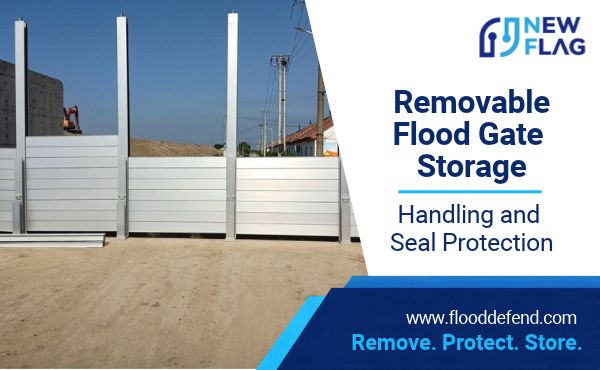

Removable flood gate storage should keep the panel supported, its seals free from damaging loads, and every required component accessible for deployment. A convenient empty corner is not necessarily a suitable storage location. The arrangement must preserve the gate’s condition and allow operators to retrieve it safely within the site’s response time.
This guide focuses on whole removable panels and their associated fittings. Stackable flood planks may need a different rack and handling arrangement. In either case, the manufacturer’s storage instructions take priority over a general preference for horizontal or vertical storage.
Storage Location and Access Route
Choose a location that remains accessible when a flood warning is issued. A basement store, remote warehouse, or room requiring unavailable keys can delay deployment even if it protects the panel well between events.
Assess exposure at the storage location. Panels and seals should be protected from avoidable contamination, impact, excessive heat, and weather according to the supplier’s guidance. A space used for fuels or aggressive cleaners may introduce material compatibility risks.
Trace the route to the protected opening. Include intermediate doors, stairs, tight corners, and changes in level. The panel’s width and height may matter more than its weight where the route is restricted.
Check whether normal business storage gradually occupies that route. A designated aisle and storage position help prevent boxes, pallets, or furniture from blocking retrieval. Include the route in periodic readiness checks.
Keep access arrangements practical outside normal hours. Record key locations or approved access methods and ensure backup operators can use them. Avoid depending on one employee who is always assumed to be available.
Panel Support and Seal Clearance
Support the panel at the points and in the orientation approved by the manufacturer. Some products can be stored upright in a purpose-designed rack; others require a different arrangement. Do not prescribe one universal orientation for all removable gates.
The support should restrain the panel without loading a gasket unnecessarily. A gate resting on its bottom seal may deform that profile over time, while a strap across a side seal can damage or displace it. Arrange supports on suitable structural areas.
Provide protection against falling or sliding. A large upright aluminum panel can become hazardous if it is only leaned against a wall. The restraint must also allow controlled removal without operators reaching into pinch points.
Do not stack heavy equipment or spare panels onto unsupported seal areas. Even if the metal panel remains undamaged, gasket compression or distortion can compromise its later fit. Use separators and supports approved for the system where several panels share a rack.
Protect projecting latches and handles. They can catch on nearby objects or be bent during retrieval. A storage rack should accommodate the complete panel geometry rather than only its flat face.
Cleaning and Drying Before Storage
After use, remove mud, silt, and loose grit using the specified cleaning method. Contamination trapped near seals can abrade the rubber during the next deployment. Inspect before wiping so hard particles are not dragged across the contact surfaces.
Use cleaners compatible with both the metal finish and gasket compound. A chemical intended for general floor cleaning may not be suitable for a flood gate seal. Follow product guidance rather than selecting a solvent because it removes stains quickly.
Allow the panel and storage supports to dry as instructed. Water retained in channels, folded covers, or padding can keep contaminants in contact with the assembly. Inspect recesses and hardware rather than judging dryness from the front face alone.
Do not cover the panel while contamination or moisture remains trapped beneath the cover. Where a cover is supplied, use it in the intended way and ensure it does not compress or distort the gasket.
If floodwater contained oil, chemicals, or other unusual contamination, request material-specific cleaning and inspection advice. A visibly clean seal may still have suffered swelling, softening, or other changes that need evaluation before reuse.
Handling Whole Removable Panels
Use the supplied handles or approved lifting points. Latches, compression screws, and seal retainers are not automatically lifting features. Carrying a panel by an unintended component can damage hardware or allow an uncontrolled release.
Assess the panel’s dimensions, weight, grip positions, and route together. A light but wide panel can be difficult for one person to control. The site’s handling plan should identify when two operators or a suitable lifting aid are needed.
Avoid dragging the panel across floors or lifting it by its gasket edge. Dragging can score the sealing surface and contaminate the bottom seal. Set the panel down on its approved supports when repositioning is needed.
| Handling stage | Main issue to control |
|---|---|
| Removal from rack | Stable restraint release and clear grip points |
| Transport | Corners, stairs, and protection of projecting hardware |
| Temporary set-down | Approved support without loading seals |
| Positioning at opening | Controlled alignment and operator space |
| Return to storage | Clean condition, correct rack position, and restraint |
Practice the route under dry conditions. This can reveal that a doorway near storage is narrower than expected or that a cart cannot turn beside the gate. Resolve these problems before a flood alert.
Labels, Components, and Tools
Label each panel with its opening identifier and any required orientation. Labels should remain readable after cleaning and should not be placed where they interfere with a sealing surface.
For divided gates, keep matched panels, center supports, and joint components together. Similar dimensions do not establish interchangeability. A part placed in the wrong storage bay can create a deployment failure at more than one opening.
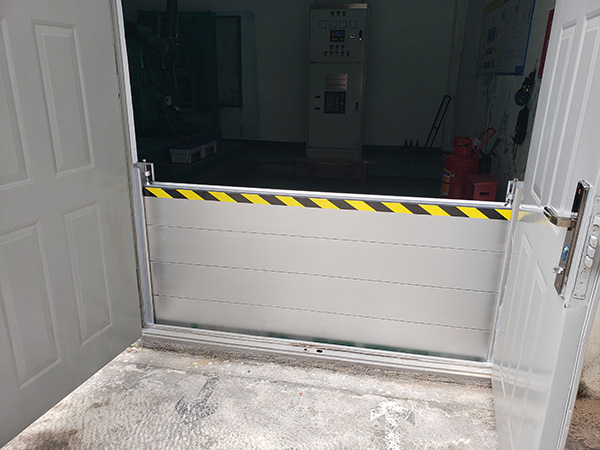
Store required tools and fittings in a clearly identified location. Include proprietary keys, compression tools, removable bolts, and approved accessories. Maintain a component list so operators can confirm that the set is complete without relying on memory.
Protect floor socket covers and small parts against loss. If a cover is removed during deployment, define where it goes until the gate is taken down. Otherwise missing covers may leave fittings exposed to dirt during normal operation.
Spare seals should also be identifiable and stored according to their own instructions. Do not fold or stretch them into an undersized box. Record the gate model and seal position so the correct spare can be selected promptly.
Readiness Checks and Storage Changes
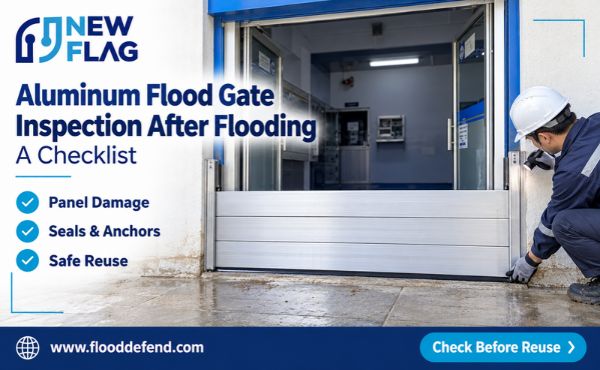
Inspect the stored panel before the expected flood season and at the intervals specified for the site. Look for impact damage, displaced seals, corrosion affecting hardware, missing components, and changes in the storage environment.
Include retrieval and dry assembly in readiness drills where appropriate. A panel can look sound in its rack while a latch has seized or the route has become blocked. The drill should begin from the real storage condition.
Record findings and corrective actions. If damage is identified, separate the panel from serviceable stock or mark its status clearly. Do not leave an unapproved component available for accidental deployment.
Reassess storage whenever the building layout changes. Relocated shelving, new locks, a different tenant, or a changed staffing pattern can affect retrieval reliability. Storage is part of the operating system rather than a one-time housekeeping decision.
After each deployment, return the gate to the same controlled arrangement and update the inventory. The next team should find a complete, inspected set in the expected place rather than reconstructing what happened during the last event.
Conclusion
Good removable flood gate storage preserves both condition and readiness. Use approved supports, protect seals from unnecessary compression, keep components identified, and practice the actual transport route. Review the arrangement after use and whenever the building changes so the gate remains available in the condition needed for its next deployment.