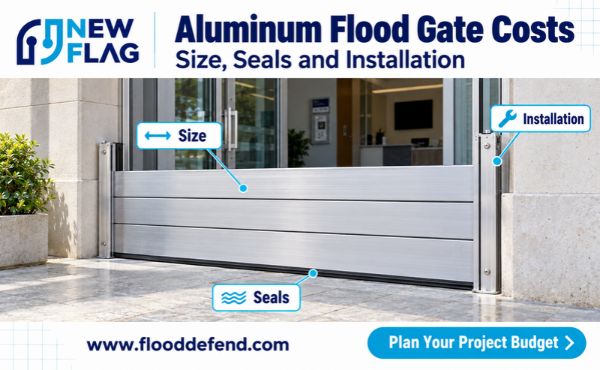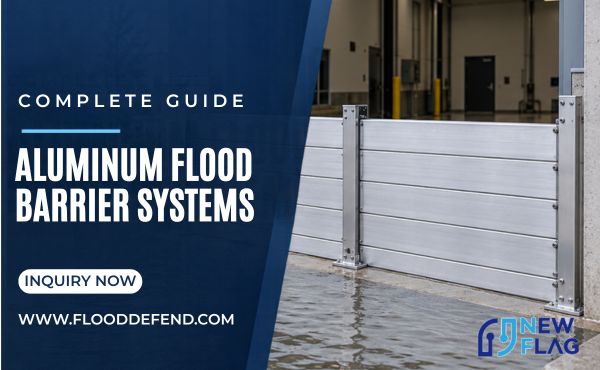

Aluminum flood gate costs depend on the opening dimensions, required water performance, panel and support arrangement, seals, and work needed at the site. A supplied panel price is therefore not the same as the installed cost of a functioning entrance protection system. Without a defined opening and scope, a single typical price can be misleading.
For procurement teams, the useful approach is to separate the factors that change the product from those that change the installation. This makes proposals easier to compare and helps explain why two gates of similar visible size may have different costs.
Product Price and Complete Project Cost
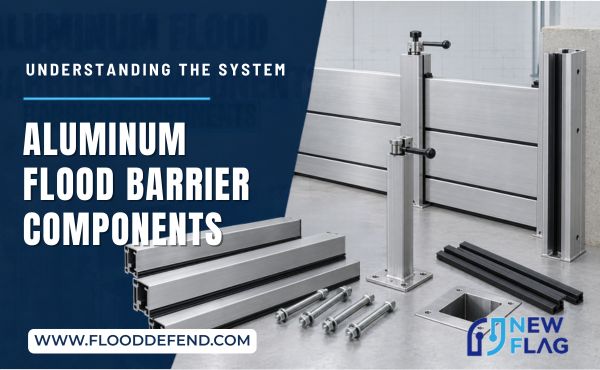
Product supply may include panels, frames, seals, and closure hardware, but the inclusions vary. Some proposals also cover floor sockets, covers, storage racks, tools, or spare gaskets. Identify these items explicitly rather than assuming they accompany the main panel.
Installed project cost can add surveys, design work, substrate investigation, site preparation, fixing installation, commissioning, training, and transport. For an existing entrance, enabling work can be a substantial part of the scope even where the panel itself is straightforward.
Clarify whether taxes, delivery to the installation location, unloading, and disposal of removed materials are included. A delivered crate at a warehouse is different from components ready at the doorway. Large panels may need planned unloading and a clear handling route.
Separate one-time work from recurring obligations. Inspection, deployment drills, seal replacement, and storage management contribute to the service cost. They should remain visible even if the initial purchasing decision focuses on capital expenditure.
Opening Size and Design Water Depth
Wider and taller gates usually require more material, but area alone does not explain the price. Increasing width can change panel construction, stiffening, center supports, and lifting requirements. Increasing the design water depth changes the water loads and may require a different configuration.
Ask whether the proposed opening remains within an existing product arrangement or requires additional engineering. A small dimensional increase can introduce a support or handling requirement rather than produce a proportional price increase.
Distinguish physical panel height from rated water depth. Comparing a taller panel with a shorter one is not a meaningful performance comparison unless both proposals state their operating conditions. A lower-priced gate may simply have been specified for a different water level.
Custom shapes, stepped thresholds, and interrupted mounting faces can add design and fabrication work. The effect depends on whether the supplier has a suitable established detail or must develop a project-specific arrangement.
Avoid using price per square meter as the sole comparison. It can overlook frames, joints, support design, and performance evidence. It may be a useful internal budgeting measure for similar configurations, but it does not establish equivalence between systems.
Panels, Supports, and Seal Construction
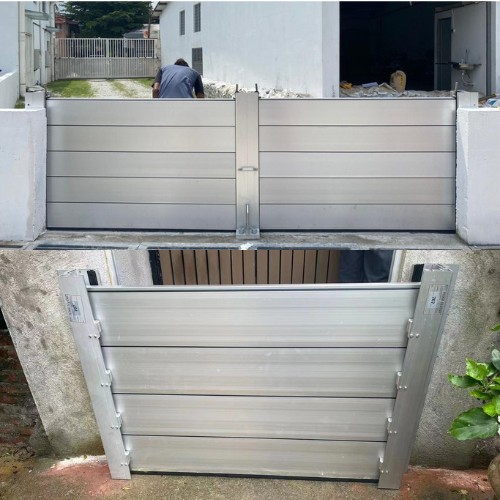
A one-piece removable gate and a divided system have different component costs. A divided gate may use smaller panels but add a center post, floor connection, joint seals, and more hardware. Evaluate the complete assembly rather than the price of each panel separately.
Panel construction also matters. Alloy designation, section geometry, stiffeners, finish, and fabrication details can vary. Ask how these features support the specified performance instead of treating a thicker-looking panel as automatically superior.
Seal cost depends on more than the rubber type. Profile geometry, molded corners, retention, number of sealing lines, and approved replacement kits can affect both initial and service costs. A low-cost generic gasket is not necessarily an equivalent replacement.
The closure mechanism affects operation and fabrication. Latches, compression screws, or other devices need to reach the approved seal condition. Compare operator requirements and spare parts alongside the initial hardware cost.
Where corrosion exposure or appearance requirements call for a particular finish or material detail, include that scope consistently across proposals. Do not compare a finished commercial entrance assembly with an unfinished supply-only panel without identifying the difference.
Site Preparation and Installation Work
Threshold repairs, leveling, and new sill details can change project cost substantially. The required work depends on the actual bottom sealing line, not just the general condition of the floor. Crossing tracks or drainage channels may need a purpose-designed solution.
Wall and floor supports need assessment. Sound structural concrete may permit a different connection from hollow masonry, weak brickwork, or a decorative shopfront. Investigation or a new support frame can add work before the gate is installed.
Access constraints affect installation effort. Restricted working hours, occupied retail premises, narrow unloading routes, and coordination with other trades can increase labor and logistics requirements. State these constraints at the inquiry stage.
| Cost category | Scope to clarify |
|---|---|
| Gate assembly | Panels, frames, supports, seals, and hardware |
| Engineering | Survey, drawings, load assessment, and custom details |
| Enabling works | Threshold, substrate, drainage, and finish changes |
| Installation | Fixings, interface sealing, labor, and access equipment |
| Handover | Checks, agreed tests, training, and records |
| Service support | Spares, inspections, and replacement availability |
The table supports scope comparison; it does not imply that every project needs every item. Mark exclusions and responsibility clearly so missing work is assigned rather than overlooked.
Deployment, Storage, and Service Costs
Removable flood gates need a storage location that preserves the panels and keeps them accessible. Racks, carts, padded supports, and labeling may be justified where handling or identification would otherwise be unreliable.
The deployment team also has a cost. Consider training time, drills, and the need for several operators or lifting equipment. For a property with multiple openings, assess the total response effort rather than quoting a single-panel installation time.
Budget for condition-based maintenance and approved replacement parts. Gasket service life varies with exposure, use, storage, and compression, so a universal replacement interval is not an appropriate cost assumption without product guidance.
Ask how long the supplier expects to support proprietary seals and hardware. Availability and lead time affect the practical value of the system, particularly where a damaged component must be replaced before the next flood season.
Do not assume the cheapest initial gate produces the lowest operating cost. Conversely, a higher price is not evidence of better performance. The comparison needs a defined protection requirement and a credible operating arrangement.
Comparable Proposals and Budget Decisions
Send all suppliers the same survey, design water level, exposure conditions, and site constraints. Require them to state the proposed configuration, applicable evidence, inclusions, exclusions, and work assigned to others.
Resolve differences before comparing totals. One proposal may include a prepared sill and training while another leaves both to the buyer. A price difference caused by scope should not be mistaken for a manufacturing efficiency difference.
For preliminary budgeting, ask for a clearly qualified estimate tied to stated assumptions. Replace it with a project-specific proposal once the survey and configuration are confirmed. Keep contingency separate from the defined supplier scope.
Record the reason for selection in terms of performance, installation, and deployment. The aim is a gate the site can use reliably, with no unresolved responsibility for the threshold or supports. A low panel price is useful only when the remaining work is understood.
FAQ
Is a custom gate always more expensive than a standard size?
Not necessarily in every market or configuration, but custom dimensions can require additional design or fabrication. Ask whether an established configuration fits the opening and what changes the custom version requires.
Can a standard gate be widened later to save initial cost?
Do not budget on that assumption. Widening changes the panel span, connections, and sealing geometry. Any modification needs manufacturer approval and may require a replacement assembly rather than a low-cost extension.
Can buying several gates reduce project cost?
A shared order may simplify logistics or repeated fabrication, but each opening still needs verification. Do not standardize incompatible panels merely to obtain a lower unit price.
Conclusion
A meaningful aluminum flood gate price is tied to a defined opening, water requirement, and complete scope. Separate product construction from site work and service obligations, then compare proposals on the same basis. This makes budgeting more reliable without inventing a universal price or overlooking essential installation work.