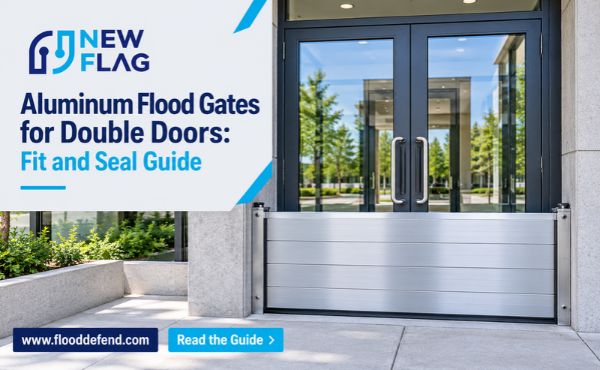
Aluminum flood gates for double doors need a design for the full entrance span, including any center joint, bottom seal, and support arrangement. The number of door leaves does not determine the number of flood panels. A double doorway may use one removable panel, two sections with an engineered center connection, or another arrangement selected for its width, required water depth, and handling conditions.
The purchasing decision therefore involves more than ordering a wider single-door gate. Buyers should examine how the system carries water loads, maintains sealing at the center, and reaches the opening from storage. These factors determine whether a proposed configuration will be practical for both the building and its operators.
The Full Entrance Span
Survey the complete opening at the intended barrier line. Measure between the actual mounting references, which may be the structural reveals or surfaces outside the existing door frame. Adding the nominal widths of two door leaves will not capture the frame, clearances, or mounting overlap.
Check the threshold across its entire width. Double entrances can contain different floor levels on each side, a central door bolt socket, or a joint where two sill sections meet. These details can interrupt the bottom sealing line even when the door leaves close normally.
Record any existing center mullion. State whether it is fixed or removable, what supports it, and whether it carries door hardware. A door mullion is not automatically a flood barrier support. Its suitability depends on the approved structural and sealing design.
Include the door swing envelope and the space beside both jambs. A wide gate frame may conflict with a closer arm, glazed sidelight, or shopfront fixture. These conflicts should be resolved before the manufacturer establishes the panel dimensions.
One-Piece and Divided Gate Arrangements
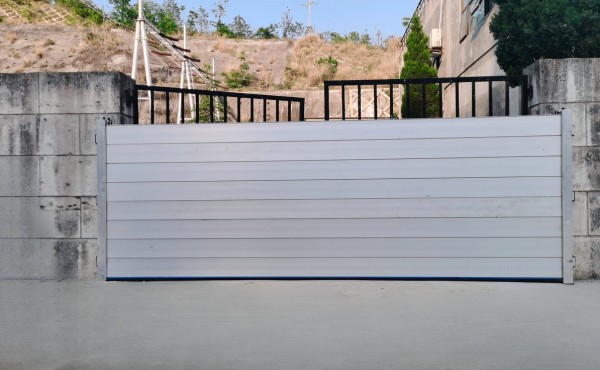
A one-piece panel avoids a vertical center joint, which can simplify the sealing layout. However, its overall size may create handling difficulties. A relatively light aluminum panel can still be awkward to turn in a corridor or hold steadily while locating it in a frame.
A divided arrangement reduces the size of each movable section. It introduces additional connections that need their own compression method, alignment features, and structural support. The benefit is worthwhile only if operators can assemble those connections reliably.
| Arrangement | Main advantage | Main point to resolve |
|---|---|---|
| One-piece removable panel | No vertical panel joint | Full-span capacity and handling route |
| Divided panels with center support | Smaller sections for transport | Center post fixing and seal intersections |
| Engineered joint without a post | Potentially clear floor after removal | Verified joint strength and compression |
| Hinged paired gate | Panels remain near the opening | Swing space and complete closure sequence |
These are configuration choices rather than interchangeable products. The supplier should identify which arrangement it offers, the supported dimensions, and the associated design water depth. A photograph showing two panels does not explain how their middle connection works.
Avoid choosing the arrangement solely by individual panel weight. Compare the total deployment process, including fetching supports, locating panels, operating clamps, and confirming the central seal.
Center Joints and Seal Intersections
Where two flood panels meet, the center connection must control both alignment and water passage. Depending on the design, this may involve a removable post, an overlapping joint, or another purpose-designed connection. Two flat panel edges pushed together do not constitute a verified seal.
The most important local detail is often the intersection between the center connection and the bottom sealing line. Several seal paths may converge there. If one component sits high, twists, or compresses differently, a small opening can remain at the junction.
Ask for a section drawing of that intersection. It should show the approved seal profiles, the compression direction, and the assembly order. This is more informative than a general statement that the gate contains rubber gaskets.
For removable center posts, examine the floor connection. The socket or base plate must support the post as designed, while its surrounding surface allows the bottom seals to work. A loose post can affect both structural behavior and joint geometry.
Keep the connection identifiable in storage. Similar-looking left and right sections may have different seal details or orientations. Permanent panel labels reduce the risk of assembling a technically correct set in the wrong order.
Span, Deflection, and Support Capacity
Floodwater applies load across the gate face. For the same water depth, a wider opening places a greater total load on the system. The way that load reaches the supports depends on the panel construction and connection arrangement.
Deflection matters as well as strength. A panel can remain intact while movement changes gasket contact or pulls a joint out of its working geometry. The supplier’s design should account for both structural resistance and the sealing behavior of the assembly.
Do not extrapolate a tested single-door configuration to a much wider double doorway without supporting evidence. Panel thickness, stiffeners, support spacing, and joint details can change. Ask which dimensions and mounting conditions the available performance evidence actually covers.
A central support can reduce the unsupported panel span, but it introduces loads into the floor. Its foundation must therefore be assessed alongside the side mountings. A socket fixed only into a thin decorative finish cannot be assumed to provide the required support.
Where the doorway includes glazing, confirm how flood loads bypass or enter the shopfront structure. Ordinary glazing frames and cover sections should not be treated as suitable gate supports without an engineering assessment.
Panel Handling and Deployment Sequence
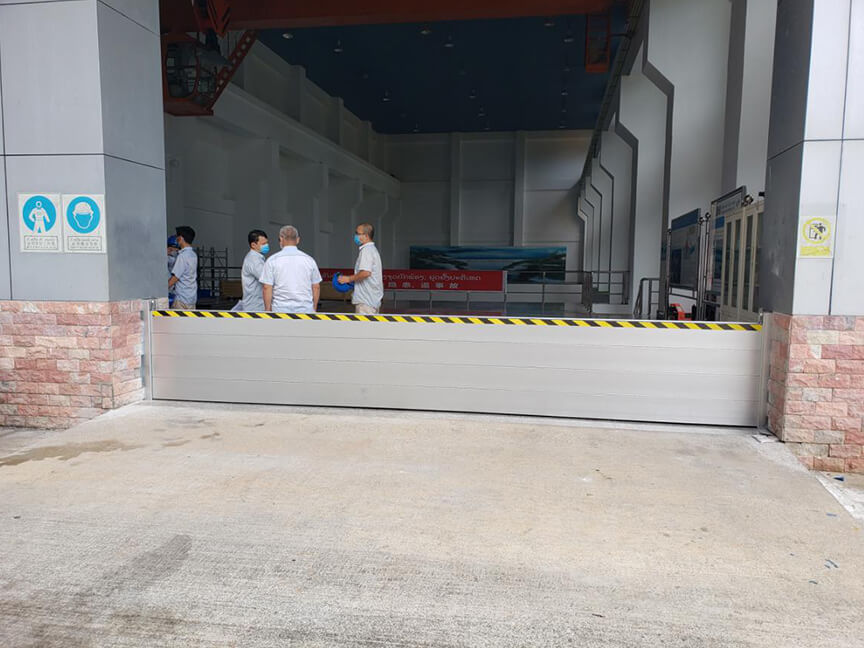
Assess the largest component using the real storage route. Check whether it fits through intermediate doors, around corners, and past shelving. Record its dimensions and supplied handles, as well as its weight.
Plan where operators stand while positioning it. A two-person lift needs room for both people to grip and move safely. If one operator must reach over the panel to secure the far side, the mounting arrangement may need reconsideration.
For divided gates, practice the complete sequence under dry conditions. Depending on the product, the center support may need to be installed before either panel, or a particular panel may need to be seated first. Follow the supplied sequence rather than inventing one from the visible parts.
Time the task from retrieval through final checks. Counting only the moment when a panel reaches the frame overlooks missing tools, locked storage, and center post assembly. Record who verifies the completed installation and what visual checks they use.
A double-door flood barrier should not depend on people stepping over it for continued business access. Once deployed, the entrance has changed function. Closure arrangements and any alternative route need to be established beforehand.
Configuration Approval and Handover
Before purchase, require a drawing showing the complete opening, frame positions, center connection, threshold, and water-facing side. Confirm whether the existing door mullion remains, is removed, or plays no role in the flood gate.
Request the full component list, including floor socket covers, seals, tools, and any dedicated lifting aids. Small missing parts can prevent deployment even when both main panels are available.
At handover, check the actual opening against the approved drawing and perform a complete dry assembly. Observe alignment without forcing parts. Difficulty seating one section can indicate a frame or threshold issue that should be corrected before acceptance.
Record each panel’s assigned opening and orientation. For a property with several double entrances, mixing panels can cause fit problems that are difficult to detect until operators attempt deployment.
Conclusion
Aluminum flood gates for double doors should be selected around the complete opening, design water depth, and deployment requirements. Reliable protection depends on suitable supports, controlled panel deflection, and continuous sealing across the threshold and any center joint. Before ordering, confirm the proposed configuration through drawings and relevant performance evidence.
At handover, verify the installed dimensions and complete a dry assembly using every required component. Clear panel identification, accessible storage, and a practiced installation sequence help operators deploy the system.