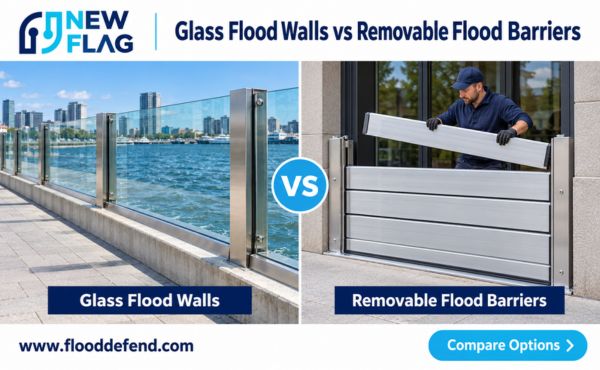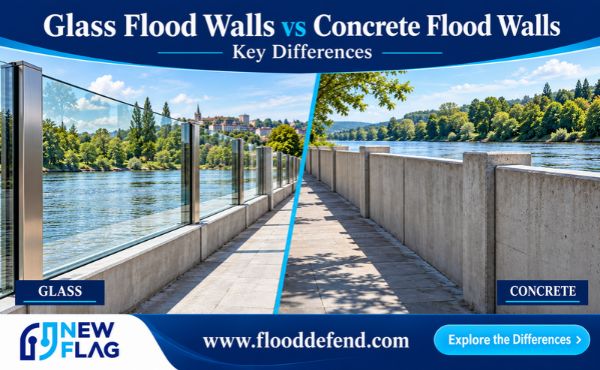

Glass flood barriers form a permanent barrier against external floodwater while preserving views and natural light. In building flood protection, their main role is to protect exposed boundaries where a solid wall would obstruct the surrounding landscape or affect how a space is used.
Their effectiveness depends on more than the glass panels. Foundations, structural supports, sealed connections, access openings and drainage all influence the protection a system can provide. For residential and commercial properties, glass flood barriers therefore need to be planned as part of a complete flood protection strategy.
The Main Roles of Glass Flood Barriers
Glass flood barriers use engineered glass panels, supporting frames and sealed connections to resist floodwater under specified design conditions. Permanent systems remain in position throughout the year, making them suitable for locations where visibility and continuous readiness are priorities.
Forming a Fixed Flood Protection Boundary
A glass flood wall creates a physical boundary between an external flood source and a protected area. Depending on the site, it may form part of a property perimeter, connect sections of an existing flood wall or protect a particular exposed frontage.
The important point is continuity. A strong wall section offers limited protection if floodwater can travel around its ends or enter through an adjacent opening. Its position must therefore follow the intended protection boundary, with appropriate connections to neighboring structures.
Preserving Visibility Where Protection Is Needed
Solid flood walls can interrupt views from buildings, terraces and shared outdoor areas. Transparent flood barriers allow designers to retain those visual connections while incorporating a permanent defense.
This matters where the relationship between a building and its surroundings is central to daily use. Residents may want to retain views from communal gardens, while businesses may need clear sightlines across outdoor customer areas.
Transparency serves an architectural purpose, but it does not establish flood resistance. That performance comes from the design and verification of the complete system.
Learn How Glass Wall Flood Barriers Balance Aesthetics & Function Here
Reducing Dependence on Emergency Deployment
Fixed glass flood walls do not require panel installation before each flood event. This reduces reliance on available staff, accessible storage and sufficient warning time.
However, continuous readiness applies to the fixed wall sections. If the protection boundary includes gates or removable barriers at entrances, those openings still require an appropriate operating plan. A permanent glass wall cannot compensate for an access point left unprotected.
Glass Flood Barriers in Residential Flood Protection
Residential flood protection must accommodate everyday living as well as potential flood events. A permanent barrier needs to fit around pedestrian access, outdoor spaces and the relationship between neighboring properties.
Glass barriers can help where an assessed flood risk justifies a fixed boundary but preserving openness remains important.
Protecting External Areas Around Homes
In suitable locations, a glass flood wall may help reduce external floodwater entering a residential site or shared outdoor area. Its transparent construction can retain views from gardens, terraces and communal spaces.
The layout should be based on how water could reach the property. Protecting only the most visible frontage may leave lower sections of the boundary or side access routes exposed.
Residential developments also need to consider shared responsibilities. Where several homes depend on one protection boundary, access arrangements, inspections and the operation of any closures should have clearly assigned ownership.
Distinguishing Perimeter Protection from Building Waterproofing
A perimeter glass flood barrier and a flood-resistant building envelope perform different tasks. The perimeter system aims to keep external floodwater away from a designated area. It does not automatically prevent water entering through underground routes, drainage connections or unprotected parts of the building.
Similarly, an external glass flood wall should not be confused with flood-resistant glazing installed within a building opening. These are different system configurations with different interfaces and approval considerations.
The suitability of residential perimeter protection must be assessed against local flood conditions and applicable requirements. Installing a barrier should not be presented as automatically making a home compliant with floodplain development rules.

Glass Flood Barriers in Commercial Flood Protection
Commercial properties often need flood protection that fits around customer access, deliveries, security and day-to-day operations. Glass flood barriers can provide fixed protection along selected boundaries while maintaining visibility across the site.
Their role is strongest where a permanent wall is appropriate and an opaque structure would interfere with the use or appearance of the space.
Supporting Everyday Use of Commercial Spaces
Transparent flood walls can help maintain the connection between indoor and outdoor areas. They may also preserve sightlines across customer-facing spaces and landscaped boundaries.
The design must account for how people move through the property. A barrier layout that protects one frontage but creates awkward access or delivery arrangements may be difficult to operate effectively.
For this reason, the flood protection boundary should be considered alongside pedestrian routes, vehicle movements and service access from the beginning.
Reducing Deployment Demands During Flood Warnings
Commercial buildings may have limited staff available outside normal operating hours. Fixed glass wall sections reduce the amount of equipment that needs to be moved and assembled when a warning is issued.
This can simplify preparations, particularly across long sections of a boundary. Remaining closures still need clear instructions covering who operates them, when they are closed and how their readiness is checked.
Glass flood barriers can help reduce exposure to flood damage, but they cannot guarantee uninterrupted business operations. Access roads, utility supplies and neighboring infrastructure may remain vulnerable even when the protected site performs as intended.
Integration with Other Building Flood Protection Measures
A glass flood barrier works within a wider system. The connections between different elements deserve as much attention as the wall panels themselves.
Connecting Walls and Structural Boundaries
Glass wall sections may connect to concrete walls, purpose-designed end supports or other suitable structures. These transitions need to maintain the intended structural and sealing performance.
An adjacent structure should not be assumed suitable simply because it appears solid. Its condition, capacity and connection details need to be assessed for the proposed role.
Changes in ground level also matter. The protection line should be reviewed across the entire site so that a lower section does not provide an unintended route for water.
Protecting Access Openings
Building sites need entrances. Pedestrian gates, driveways and service routes can interrupt an otherwise permanent flood wall.
Appropriate flood gates or demountable barriers may be used at these locations, depending on the project. Their design must address the opening itself and its connection to the fixed glass sections.
This creates a practical distinction: most of the boundary may be permanently ready, while individual openings still depend on closure before floodwater arrives.
Managing Water Within the Protected Area
Blocking external floodwater does not remove water generated inside the boundary. Rain can still fall on roofs, paved surfaces and landscaped areas.
Drainage planning should therefore consider where this water goes when external water levels are high. Depending on the site, the assessment may need to address drainage backflow, restricted discharge and the need for pumping.
Glass walls and drainage serve complementary functions. The wall restricts external water entry, while the drainage strategy manages water within the protected area.
The Limits of Glass Flood Barrier Protection
A useful flood protection plan explains both the intended performance and the conditions outside it.
Protection is limited by the assessed design conditions. Water depth, loading, impact exposure and supporting structures influence what a system can withstand. Performance should be supported by relevant project information and testing rather than assumed from appearance.
Floodwater may find another route. Water can bypass an incomplete boundary, enter through an unprotected opening or exceed the planned protection level. Underground ingress and drainage connections may require separate measures.
Permanent installation still requires maintenance. Glass panels, seals, supports and connections need inspection appropriate to the system and site. Damage or deterioration should be assessed before it compromises readiness.
Property owners should also have a plan for conditions beyond the intended protection level. A flood barrier reduces a defined risk; it does not eliminate the need for warning procedures and emergency planning.
Conclusion
Glass flood barriers provide fixed protection where buildings need to retain views and an open appearance. For residential properties, they can support perimeter protection while accommodating outdoor living and shared access. For commercial sites, they can reduce deployment demands while fitting around daily operations.
Their value depends on a complete protection boundary, suitable access closures and coordinated drainage. Planning these relationships early helps establish where glass barriers are appropriate and what additional measures the site needs.