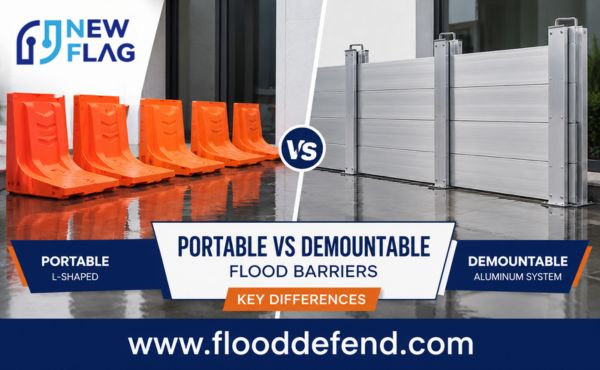
Portable and demountable flood barriers are both designed to provide temporary protection against rising water, but they are not the same type of system. The main difference is how they are installed and where they are intended to be used.
A portable flood barrier is designed to be transported and positioned wherever flood protection is needed. A demountable flood barrier is normally installed at a predetermined opening using permanent fixing points, while the barrier panels themselves can be removed when there is no flood risk.
This distinction affects installation, mobility, site preparation, deployment, and suitable applications. Understanding these differences helps determine which system is more appropriate for a particular flood-prone location.
What Is a Portable Flood Barrier?
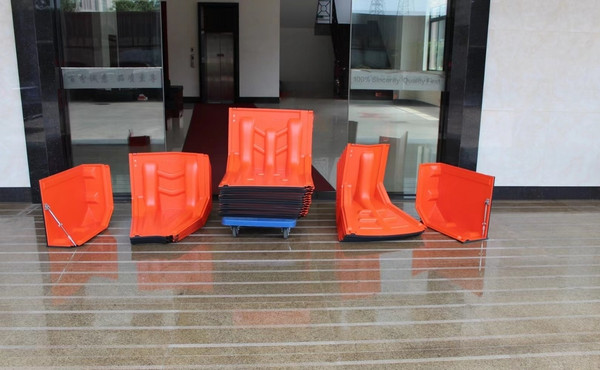
A portable flood barrier is a movable flood protection system that can be deployed temporarily in front of areas exposed to incoming water.
Unlike a permanently installed flood wall, the barrier is normally stored when not required and moved into position before or during a flood warning.
Depending on the design, portable barriers may use interconnected modules, weighted sections, water-filled structures, or self-supporting panels. Some systems rely partly on the pressure or weight of approaching water to improve stability.
The defining feature is that the barrier is not permanently tied to one specific opening.
Portable flood barriers can therefore be used across different areas of the same site. For example, a facility may deploy the barrier around a loading area during one flood event and across a vehicle entrance during another.
They are commonly used for:
- Roads and access routes
- Construction sites
- Commercial properties
- Industrial facilities
- Temporary work areas
- Large open spaces
- Emergency flood response
Their flexibility makes them particularly useful where the location or direction of floodwater cannot always be predicted precisely.
What Is a Demountable Flood Barrier?
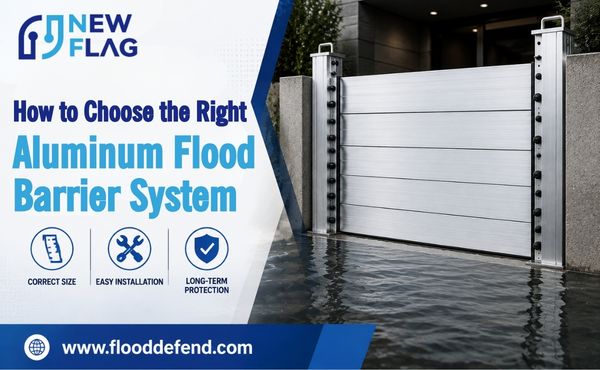
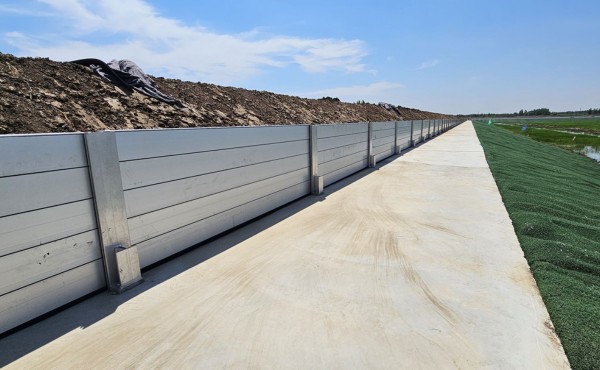
A demountable flood barrier is a removable barrier system that normally works with permanently installed structural components.
Typical installations include side channels, posts, anchors, floor sockets, or other fixed mounting points. When flooding is expected, removable panels or beams are installed into these supports to close the opening.
Once the flood risk has passed, the barrier panels can be removed so that the doorway, driveway, or access point can return to normal use.
This makes demountable barriers especially suitable for locations where the vulnerable point is already clearly identified.
Common applications include:
- Building entrances
- Doorways
- Garage entrances
- Warehouse doors
- Loading bays
- Driveways
- Underground parking entrances
- Industrial gates
Unlike portable barriers, demountable systems are usually designed around a specific opening width and protection height.
Installation Method Is the Main Difference
The clearest difference between portable and demountable flood barriers is their installation method.
Portable barriers are normally positioned directly on the ground where protection is required. Many designs need little or no permanent attachment to surrounding structures.
Individual sections may be connected together to create a continuous barrier line. This allows the system to follow the shape of a site or cover a wider area.
Demountable barriers work differently.
Before the system can be used, permanent mounting components are generally installed at the protected location. These may be fixed to walls, floors, columns, or structural openings.
During deployment, removable flood panels are placed into these prepared fixing points.
This means portable barriers prioritize location flexibility, while demountable barriers prioritize repeatable installation at a fixed location.
Mobility and Flexibility
Mobility is one of the strongest advantages of portable flood barriers.
Because the system is not permanently assigned to one opening, it can often be transported to different flood-prone areas.
This is useful for large industrial or commercial sites where water may enter from several directions depending on rainfall intensity, drainage conditions, or surrounding water levels.
Portable modular barriers can also be arranged into different configurations. The barrier line may be extended, shortened, curved, or repositioned depending on the system design and site conditions.
Demountable barriers offer less flexibility in this respect.
Once the mounting points have been installed, the removable panels are generally intended for that specific location. Moving the system somewhere else would normally require additional mounting hardware or site preparation.
For this reason, demountable barriers are more appropriate when the flood entry point is known and does not frequently change.
Site Preparation Requirements
Portable systems usually require less permanent site preparation.
Many systems can be deployed directly onto suitable ground without installing wall channels or fixed posts. However, surface condition still matters. The ground must usually be suitable for stable positioning and effective contact between the barrier and surface.
This makes portable flood barriers useful where permanent structural modifications are undesirable or impossible.
Demountable barriers require more preparation before their first use.
A typical system may need:
- Wall-mounted channels
- Removable or permanent posts
- Floor sockets
- Anchoring points
- Sealing surfaces
- Structural fixing hardware
This initial installation creates a prepared flood protection point.
Afterward, repeated deployment can become relatively straightforward because the position and supporting structure are already established.
The trade-off is therefore clear: portable barriers reduce fixed infrastructure, while demountable barriers use fixed infrastructure to simplify repeated protection of the same location.
Deployment and Flood Response
Both systems can provide relatively rapid flood protection, but their deployment process is different.
Portable barriers must first be transported to the threatened location. Individual modules are then positioned, connected, and aligned to form the required protection line.
This is particularly valuable for emergency response because the barrier can be sent to wherever protection is most urgently needed.
Demountable barriers usually remain stored close to a predetermined location. During a flood warning, panels or beams are brought to the opening and fitted into the permanent supports.
Because the mounting position has already been prepared, installation can be efficient and consistent.
Therefore, deployment speed should not be viewed simply as one system being faster than the other.
Portable barriers are effective because they can be rapidly relocated, while demountable barriers are effective because they can be rapidly reinstalled at an existing protected opening.
Which System Is Better for Building Openings?
For clearly defined building openings, demountable flood barriers are often the more practical solution.
A doorway, garage entrance, loading bay, or underground parking entrance has a fixed width and predictable flood entry point.
Permanent side channels or mounting points can be installed around the opening while the central barrier panels remain removable.
During normal conditions, the opening stays accessible. When flooding threatens, the panels are installed to create a temporary water barrier.
Portable barriers can also protect building entrances, but their main advantage becomes more important when protection extends beyond one opening.
For example, if water needs to be diverted around an entire building frontage, across a road, or around an outdoor operational area, a portable modular barrier may provide greater flexibility.
Portable vs Demountable Flood Barriers Comparison
| Feature | Portable Flood Barrier | Demountable Flood Barrier |
|---|---|---|
| Installation location | Flexible | Predetermined |
| Permanent mounting | Usually limited or unnecessary | Usually required |
| Mobility | High | Low |
| Reconfiguration | Often possible | Normally limited |
| Initial site preparation | Lower | Higher |
| Repeat use at same opening | Possible | Particularly suitable |
| Large open areas | Highly suitable | Less suitable |
| Doors and entrances | Suitable | Highly suitable |
| Emergency relocation | Strong advantage | Limited |
| Normal access | Barrier fully removed | Panels removed; mounts may remain |
When Is a Portable Flood Barrier the Better Choice?
A portable flood barrier is generally the better option when flood protection requirements may change between events.
It is especially useful when:
- Several locations may need protection.
- Floodwater can approach from different directions.
- The required barrier length may change.
- Permanent construction is not practical.
- Roads or open areas need temporary protection.
- The barrier may need to be transferred between sites.
- Emergency deployment flexibility is important.
The main benefit is adaptability. One system can potentially respond to different flood scenarios instead of being permanently dedicated to one opening.
When Is a Demountable Flood Barrier the Better Choice?
A demountable flood barrier is generally better when the same opening needs repeated flood protection.
Typical situations include doors, warehouse entrances, garage openings, loading bays, gates, and underground parking access points.
It is particularly appropriate when:
- The flood entry point is known.
- The same location experiences recurring flood risk.
- Permanent fixing points can be installed.
- The opening must remain accessible during normal conditions.
- Consistent barrier positioning is important.
- The system will be deployed repeatedly at the same location.
The removable panels provide temporary protection without permanently blocking access.
Conclusion
Portable and demountable flood barriers both provide temporary flood protection, but they are designed for different operating conditions.
Portable flood barriers are best suited to flexible, changing, or wide-area protection. They can be transported, repositioned, and configured according to the location of the flood risk.
Demountable flood barriers are better suited to repeated protection of fixed openings. Permanent mounting points remain in place, while removable panels are installed only when flooding threatens.
The key question is therefore not simply which barrier is better. It is whether the site requires movable protection across different locations or repeatable protection at one defined opening.